In our series aptly named Butchered & Bolted, we continue to shine a light on the actions of the British SAS murder machine.
“Paul Wood (ex-BBC foreign correspondent for 25 years) writes in, The Spectator, ‘The phalanx of lawyers armed with the European Convention on Human Rights (ECHR).’
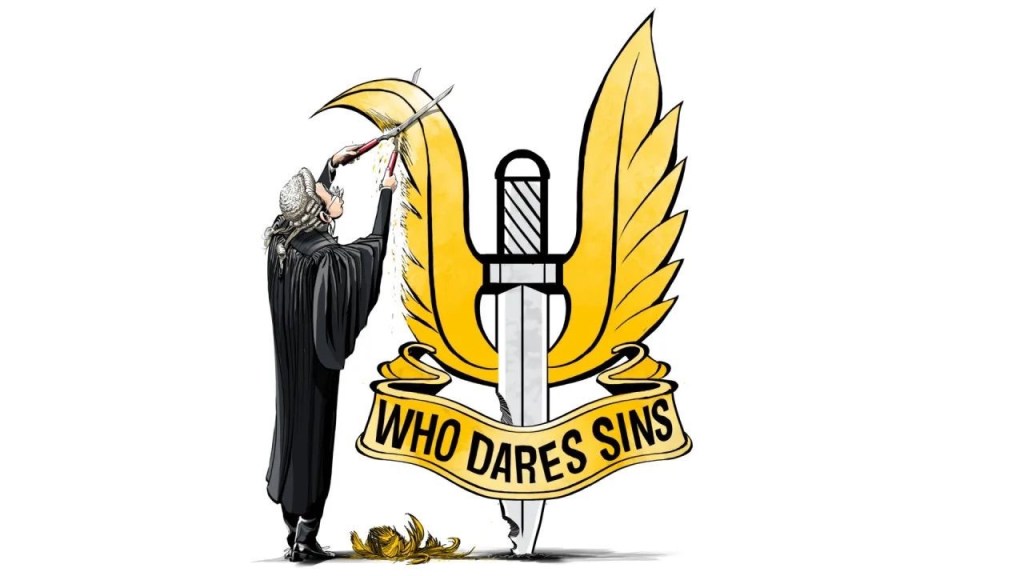
“According to Paul Wood, many SAS soldiers now believe that if they kill a terrorist during an operation, they’ll spend decades being hounded through the courts. One such case is that of Soldier M and the actions of his fellow SAS mercenaries. Woods asserts that this has become more prevalent within the Occupied Six Counties. This has stemmed from legacy cases caused by the British army who ran an undercover unit that operated a British government sanctioned shoot-to-kill policy against Irish republicans. They were murdered without any attempt being made to arrest them.
“On a February night in 1992 four members of the IRA’s East Tyrone brigade set out to attack Coalisland RUC station with a heavy machine gun mounted on the back of a lorry.
“How could you begin to fathom, what lay ahead for these brave sons of Éire? We will never know the full extent of what they were thinking. Yet their families should be assured that the love they held was front and centre. As Irish republicans they would have known from a young age that life in Occupied Six Counties was not ordinary, and that whoever is born here must realise that the road to freedom is long and hard. Being volunteer soldiers they were fighting to achieve the All-Ireland Republic’. An Ireland unfettered by foreign control or domestic divisions cultivated by the foreigner.
“We offer our gratitude to the families for bringing to the fore information, that substantiates Soldier M and his fellow SAS mercenaries had been preparing for slaughter. As well as the growing knowledge that the British army’s so-called rule book of engagement, standards and accountability were and are non-existent.
“Today the families are once again trying to have these SAS murderers account for their murderous actions. We support the families’ legal journey to seek justice through ECHR’s Article 2, which protects ‘everyone’s right to life’.
“According to George Simms, a former Regimental Sergeant Major in the British army (RSM) who wore the winged dagger for 23 years who has broken the SAS so-called strict omertà and gone public. Simms has exerted his efforts and shown his affinity to Soldier M. He declares that he’s ‘one of my young lads’ and goes onto celebrate that (M) had served 34 years in the SAS while for 20 years he has been fighting a legal process over his actions in February 1992.
“Simms also claims ‘the mood in the camp is dark. The good guys have become the bad guys and the bad guys are now the good guys’. He talks about the ‘increasingly pious, tut-tutting antics of those who control this country, when faced with the effects of their political decisions’, i.e., committing lethal force to their foreign policy adventures in the form of the SAS and the wider military.
“Paul Woods concurs with such claims and has spoken to former SAS soldiers who say that stories of men being ‘dragged back to be screamed at in interview rooms’ are ‘flying around the canteens now’.
“Woods also states there has been fear-mongering in Whitehall amongst the British political class. They are talking about one day those men (SAS) may not be there when and if the British public turn to them for help. They have even gone as far as eulogising Churchill: ‘”e sleep soundly in our beds because rough men stand ready in the night to visit violence on those who would do us harm.’
“As Irish Republicans we must continue to fight against British occupation in Ireland. We must also carry in our hearts the willingness to succeed in bringing about ‘the republic’ and believe in a future political landscape consisting of Éire Nua, our blueprint for a united Ireland.
“We understand that this is not just a passing struggle, but rather our destiny that we carry until the last drop of our blood. The British enemy wants us to abandon the resistance and to turn our cause into an endless negotiation.
“We must hold compassion and truly understand that the loved one’s who were murdered that February 1992 had an innate enthusiasm defying punishment. They died for a cause that was greater than any British army omertà: the cause of Irish freedom.
Ranganna:[RSF News] Statements
 Republican SINN FÉIN Poblachtach